
2 WEEK COHORT EVENT PAGE
September 28th - October 11th
FACEBOOK GROUP
This is the place to ask questions and recieve feedback for the program.
JOIN FACEBOOK GROUPGUIDING PRINCIPLES
1. Stack First
Many people find movements feel more stable when the ribs and pelvis stay relatively organized. A helpful starting point is to think about:
- breathing into the sides and back
- avoiding excessive rib flare
- standing or lifting tall rather than leaning back
If you lose that organization during a lift, reducing range or load often helps restore it.
2. Tension Before Range
In this program, muscular tension is prioritized over maximal depth. Many people notice lifts feel more stable when they:
- move only through ranges they can control
- avoid resting on passive end-range positions
- slow down the lowering phase when learning a movement
Exploring where tension appears in your body can help you find the range that works best for you.
3. Use Reps in Reserve (RIR)
Loads are guided by Reps in Reserve (RIR). This means stopping a set when you feel you could still complete a few more reps with good form. For example:
- 3 RIR = about three reps left in the tank
- 2 RIR = about two reps left
- 1 RIR = about one rep left
Many people find that maintaining this buffer helps keep training productive while reducing unnecessary fatigue.
4. Adjust for Your Body
Different bodies organize lifts differently. You may choose to adjust:
- stance width
- depth
- loading strategy
- tempo
The goal is always the same: a lift that feels organized, controlled, and repeatable.
5. Explore, Don’t Force
Strength training often works best when you explore positions rather than forcing them. You might notice certain setups feel more stable or certain cues help a movement click. Those observations are valuable information about how your body prefers to organize the lift. Over time, those small adjustments often lead to stronger, more consistent movement. It should feel challenging, but the movements should remain organized.
If a lift begins to feel unstable or uncomfortable, experiment with:
- slightly reducing the load
- shortening the range of motion
- slowing the lowering phase
- revisiting the setup cues from the demo videos
These adjustments are a normal part of learning new lifts.
Hypermobility Notes:
Many aerialists have access to a large range of motion. In strength training, the goal isn’t to eliminate that mobility. Instead, the goal is to build strength and control within it.
Some people with hypermobility find the lifts feel more stable when they:
- prioritize tension over depth
- move slightly slower on the lowering phase
- avoid resting in passive joint positions
- use external feedback such as walls, bands, blocks, or shortened ranges when helpful
- reduce load or range when stability begins to disappear
Many people find it helpful to stop the range of motion where muscular tension is still present rather than moving into the deepest available position. Over time, strength training often helps mobility feel more supported and usable, both in the gym and in aerial training.
SESSION OVERVIEW
Each session is designed to take about 30 minutes. Many people find this pacing works well:
- ~90 seconds rest between accessory sets
- ~2–3 minutes rest before heavier sets
If you are short on time, focus on completing the primary lifts first.
Loads in this program are guided by Reps in Reserve (RIR). This means stopping a set when you feel you could still complete a few more reps with good form. (3 RIR = about three reps left in the tank.)
The first week is about learning the movements, not maximizing load. For your first session, start lighter than you think you need. A helpful approach is:
- choose a weight that allows you to clearly stay within the target RIR
- focus on exploring the movement and positions
- increase the load gradually in later sessions if the sets feel controlled
VIDEO LIBRARY
All exercise demonstrations for Sovereign Strength are included in one password-protected Vimeo slideshow.
Password: 2Weeks!
Video LibraryWORKOUT SEQUENCES
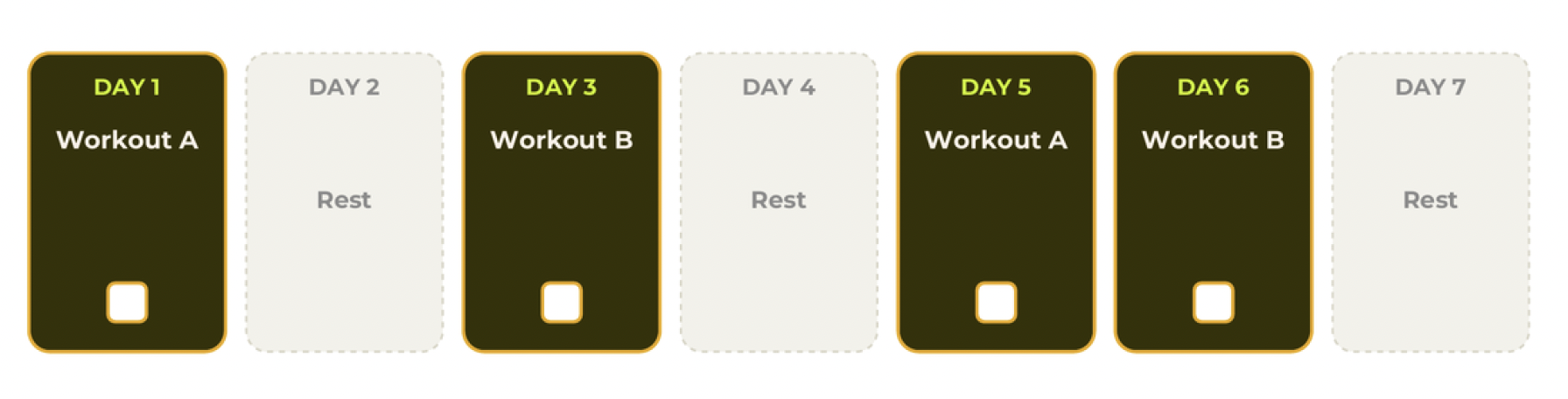
WORKOUT A
Warm Up
- 90-90 Hip Lift With Reach (2 rounds of 4 breaths)
- Split-Stance Cable Row (2 sets of 8 reps each side)
Workout
A1) Front Squat Ramp: 1-2 short sets gradually building weight
- Top Set: 1 set x 4-6 reps @ 2 RIR
- Back-Off: 1 set x 4-6 reps @ 3 RIR
A2) Half-Kneeling Lat Pulldown
- 3 sets x 6-8 reps each side @ 2 RIR
B1) Neutral Grip DB Bench Press
- 3 sets x 6-8 reps @ 2 RIR
B2) Chest Supported DB Row
- 3 sets x 6-8 reps @ 2 RIR
C) B Stance RDL with Contralateral Load
- 2 sets x 6 per side @ 2–3 RIR
WORKOUT B
Warm Up
-
90 Hip Lift With Reach (2 rounds of 4 breaths)
-
Split-Stance Cable Row (2 sets of 8 reps on each side)
Workout
A1) Romanian Deadlift Ramp: 1-2 short sets gradually building weight
- Top Set: 1 set x 4-6 reps @ 2 RIR
- Back-Off: 1 set x 4-6 reps @ 3 RIR
A2) Half Kneeling Landmine Single Arm DB Press
- 3 sets x 6-8 reps each side @ 2 RIR
B1) Strict Pullup (Sovereign Strength)
- 3 sets x 3-5 reps @ 2 RIR
B2) Incline DB Chest Press
- 3 sets x 6-8 reps @ 2 RIR
C) Deficit Reverse Lunge
- 2 sets x 6-8 reps each side @ 2-3 RIR
SUGGESTED WORKOUT SCHEDULE